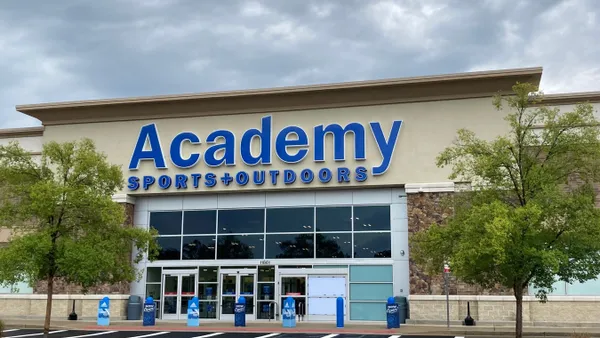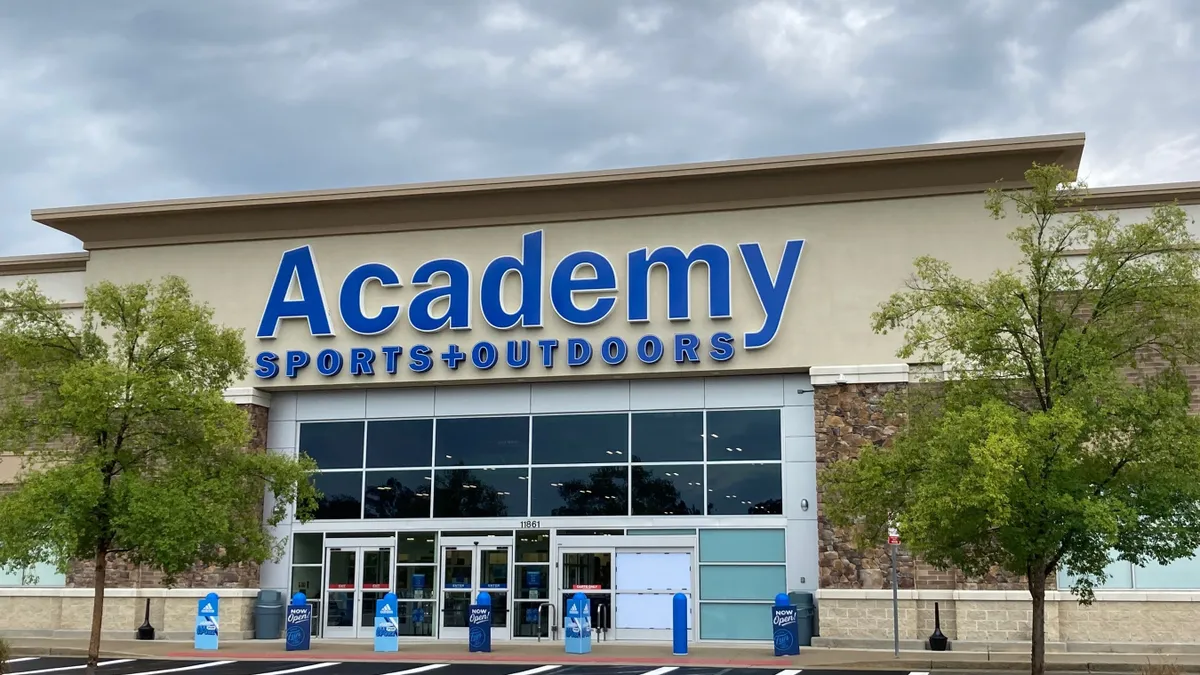
Academy Sports and Outdoors has big competitors — Dick’s Sporting Goods made more than double what Academy did last year — but its solution for growth is going small.
Academy CEO Steve Lawrence said on an analyst call earlier this month that the sporting goods retailer plans to open 125 stores over the next five years (an increase of almost 40%), but it’s not prioritizing locations close to major cities. Rather, the retailer is pursuing an “outside-in” strategy that focuses on opening stores primarily in exurbs and satellite markets before attempting to move inward.
Approximately 40% of those stores will open in legacy markets, 40% will open in states Academy has operated in for at least five years and 20% will open in new markets. The strategy puts Academy closer to where its customers actually are, according to Lawrence. It also pushes the retailer out of the densely populated areas where Dick’s often opens stores.
Three examples of this new store strategy — in Searcy, Arizona; Zanesville, Ohio; and Palestine, Texas — are roughly 20 to 50 miles from the nearest Dick’s. Others are closer, including a planned location in Celina, Texas.
But all, according to Academy, are focused on capturing the “Always Game Family,” who plays sports, fishes, hunts and focuses on value.
“We think by having this outside-in strategy, we're going to be able to build brand awareness in these new markets and then push our way into the outer suburbs over time,” Lawrence said.
It’s a sound strategy for a retailer like Academy, according to Matt Powell, senior adviser with BCE Consulting.
“Smaller markets are many and most are underserved,” he said in emailed comments, noting that Hibbett pursued a similar strategy at the beginning. “Hibbett’s early business model was to be the only sneaker store in small markets.”
Likewise, Lawrence said at the company’s investor day that he believes Academy is “the best sports and outdoor retailer in our geography.” In some smaller markets, one of the only competitors offering athletic and outdoors goods is Walmart, Lawrence said, leaving a gap for Academy to fill.
“The population is not big enough to support a full-line just sporting goods-only store or a full-line only outdoor store,” Lawrence said. “The fact that we have both sides of the box and carry other things like outdoor puts us in kind of a unique position.”
Also in service of those customers is a broader assortment of goods, both in terms of category and quality. Academy Chief Merchandising Officer Matt McCabe told Retail Dive that the retailer’s assortment expansions are intended to support how customers live their lives; that means providing organizational solutions for sports gear, portable power products for activities like camping and even pet goods.
“It's never going to be a big business for us,” McCabe said of pets, “but it's something that we know that we can have in the store as kind of an accessory … to help our customers pick something up easier and just allow them to go to fewer stores.”
Academy is also increasing the number of high-quality products it sells to avoid losing customers as they grow more proficient in their chosen activity. In the past, the retailer has sold a lot of opening price point items, which it dubs a “good” level. But when it came to “better” and “best” levels of product, it was lacking.
“We were a great place to get your kids their first gear for T-ball … when they decided six months later they hated T-ball and they wanted to play soccer, you could come back in and not break the bank again and move them on to soccer,” McCabe said. “But what we found was — if they stuck with baseball — when they got to about eighth grade or so we were graduating them to other places to get their gear.”
The retailer has worked for several years to improve its “better” and “best” assortments, so that shoppers can stay with Academy even as they become more proficient in their chosen activity. That includes not just sports, but also outdoor pursuits like fishing or even casual activities like barbecuing.
“That's allowed us to expand the customers that we cast a net to and carry them on their entire journey, from when they get started through when they're an expert,” McCabe said. “And along the way, that's allowed us to attract a more affluent customer into our stores as well that maybe wouldn't have thought of us for that in the past, but now comes in and finds that merch and appreciates some of the other value we have in the store too.”
Indeed, Chief Financial Officer Carl Ford said customers with a median household income of $100,000 or more are now Academy’s fastest-growing demographic, which helps to balance out the price pressures facing lower-income households. Still, about half of the retailer’s merchandise mix is at the “good” level, to ensure that Academy doesn’t leave behind its core customer base, McCabe noted.
“Our goal here is not to move away from our existing customer base to attract newer customers. That's like the quintessential mistake in retail,” Lawrence said. “We want to expand our reach.”